
Most people pack their bags before they pick up a book. That's the wrong order. The best Himalayan reads — from
Krakauer's Into Thin Air to Herzog's Annapurna — don't just tell you what these mountains look like. They tell you
what it feels like to stand in front of them. Here's what we recommend reading before you go.
Best Himalayan Trekking & Mountaineering Books
Table of Contents
Best Himalayan Trekking & Mountaineering Books
There's a specific type of customer we see every spring and autumn.
They've just booked a trek. Maybe Annapurna Circuit, maybe Everest Base Camp, maybe something less trafficked in the Mustang or Dolpo. They walk in looking slightly overwhelmed—excited but not quite sure what they're getting into—and they want to read before they go.
We've been helping those customers since 1984. This list is the distillation of four decades of those conversations.
Before We Start: Two Types of Books
Himalayan trekking and mountaineering books split into two very different categories, and you want both. The first is the practical: trail guides, route descriptions, altitude maps, logistics. These tell you where the teahouses are, what the path looks like after the monsoon, how to get from Lukla to Namche Bazaar without a wrong turn.
The second is the experiential: the accounts, the memoirs, the narratives written by people who climbed or trekked or nearly died on these mountains. These don't help you pack. They help you understand what you're walking into—the scale of the Himalayas, the culture of the climbing world, what it actually feels like to be very high up and very committed.
Read both. The practical books will get you there. The narratives will mean you actually see what you're walking through.
Into Thin Air—Jon Krakauer
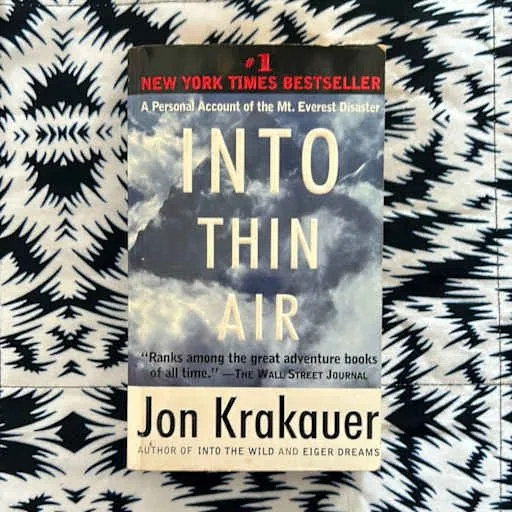
You've probably heard of this one. Read it anyway.
Published in 1997, Into Thin Air is Krakauer's account of the 1996 Everest disaster—a summit season that killed eight climbers in a single storm. Krakauer was on the mountain as a journalist for Outside magazine and survived. Several of his teammates didn't.
The book is gripping in the way that only true stories about genuine catastrophe can be. But what makes it worth reading before a trek—even if you're only going to base camp, nowhere near the summit—is what it communicates about the mountain's scale and indifference. Everest doesn't care. The Himalayas don't adjust for human ambition. Understanding that before you arrive changes how you move through the landscape.
It's also a serious piece of reporting. Krakauer is a good journalist and a precise writer. The controversy the book generated in the climbing community is its own story, but the narrative itself holds up.
We stock it consistently at Pilgrims. It moves faster in spring and autumn, so come in early if you're planning ahead.
Annapurna—Maurice Herzog
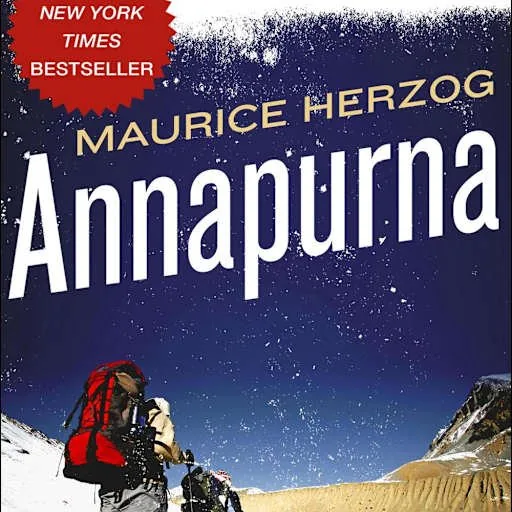
If Into Thin Air is the modern classic, Annapurna is the original.
In 1950, French mountaineer Maurice Herzog led the first expedition to summit an 8,000-metre peak—Annapurna I, in Nepal's Annapurna massif. The team succeeded. Herzog and his climbing partner Louis Lachenal reached the summit on June 3rd, 1950. The descent nearly killed them both. Herzog lost all his fingers and toes to frostbite.
His account of the expedition is one of the best-selling mountaineering books ever published, and it's not hard to understand why. It reads like survival literature. The suffering in the descent chapters is specific and unsparing. And there's something philosophically strange and compelling about how Herzog writes about the summit—joy and terror in the same sentence.
If you're trekking in the Annapurna region, reading this first makes the mountains you're looking at feel different. You know what happened there. It changes the view.
The Snow Leopard—Peter Matthiessen

This is not a mountaineering book. It is not really a trekking guide either.
The Snow Leopard (1978) is an account of a journey into the Dolpo region of Nepal—one of the most remote areas in the Himalayas—with wildlife biologist George Schaller to study the Himalayan blue sheep and search, with almost no expectation of success, for the snow leopard. It's also a meditation on grief, Zen Buddhism, and attention.
Matthiessen had recently lost his wife to cancer. The trek becomes, without being sentimental about it, a way of moving through loss. The landscape—the high passes, the cold, the emptiness—is described with a naturalist's precision and a writer's ear.
This is the book we recommend most to people who want to understand what Nepal's interior landscapes actually feel like, not just what they look like. It won the National Book Award in 1979. It deserves every word of the praise it received.
Touching the Void—Joe Simpson
In 1985, Joe Simpson and Simon Yates attempted the west face of Siula Grande in the Peruvian Andes. On the descent, Simpson fell and broke his leg through the knee joint. Yates, unable to hold his partner on a rope in the dark and the storm, made the decision that saved his own life and should have ended Simpson's: he cut the rope.
Simpson survived anyway. Crawling. For three days.
Touching the Void is Simpson's account of those three days. It's one of the most intense survival narratives ever written about the mountains—not the Himalayas specifically, but the experience of being in extreme terrain with your body failing is universal. If you want to understand why people who have had experiences like this keep going back to the mountains, this book will both answer that question and leave you more confused than before.
Read it. It'll rearrange something in how you think about risk and will.
Eight Summits: Great Himalayan Ascents—Various
For a broader view of Himalayan climbing history, anthologies and survey books are useful. We carry several at Pilgrims that cover the major ascents—the first summits of each 8,000-metre peak, the famous disasters, the solo climbs, the expeditions that changed how the mountains were understood.
Ask us in-store for what we currently have; stock in this category turns over regularly and the best available changes.
Practical Trekking Guides
Lonely Planet Trekking in the Nepal Himalaya
The standard. Updated regularly, reliable route descriptions, honest about difficulty levels. Not a substitute for a local guide on more technical routes, but for the major established treks—Annapurna Circuit, Everest Base Camp, Langtang—it's the starting point.
Buy the most recent edition you can find. Trail conditions, teahouse availability, and permit requirements change. An edition from five years ago will have outdated information on all three.
Trekking in Nepal: A Traveler's Guide—Stephen Bezruchka
More thorough than the Lonely Planet guide and more opinionated. Bezruchka is a physician who has trekked extensively in Nepal, and the medical sections on altitude sickness and acclimatization are particularly good.
If you're doing a serious high-altitude trek, the altitude sections alone are worth the price of the book. Altitude sickness is the thing that most commonly ends treks early and sends trekkers to hospital. Understanding the symptoms and what to do about them before you're on the trail is not optional.
Himalayan Permit Guides and Maps
We also stock a range of topographical maps and permit documentation guides for specific treks. These change more often than books as the Nepal government regularly adjusts permit requirements and trekking regulations. Come in and tell us where you're going—we'll make sure you have what you need.
The Rare and the Specialist
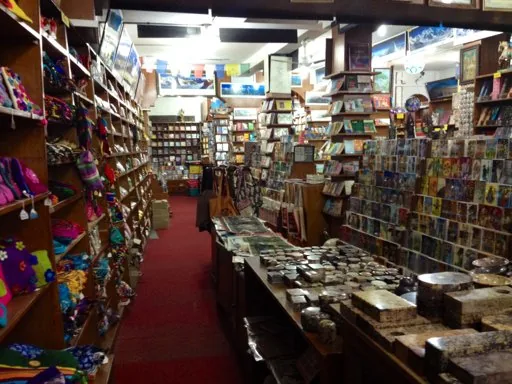
Pilgrims has been collecting and stocking rare Himalayan literature since 1984. This is actually one of the things we do that you won't find easily elsewhere.
Early expedition accounts — the pre-war British Everest expeditions, the early French and Italian Himalayan efforts—exist in limited print runs and can be difficult to source. We regularly have copies of titles that are technically out of print. If you're a collector or a serious reader of mountaineering history, it's worth asking us what we have.
Some things we've had in stock over the years:
- The Fight for Everest: 1924—the account of the Mallory and Irvine expedition. Whether they summited before they died remains one of mountaineering's great unresolved questions.
- Early surveys and natural history accounts from British India-era expeditions into the Himalayas
- Out-of-print Nepali-language accounts of expeditions led by Nepali climbers—a category that gets far less attention than it deserves
If you're looking for something specific and rare, email us before visiting. We'll let you know if we have it.
What to Read Before You Go
Read the practical guide for logistics.
Read one narrative—Into Thin Air, Annapurna, The Snow Leopard, depending on where you're going—to understand the scale and the culture.
And then, when you're on the trail and you're passing through a village and you see something you don't quite understand, let what you've read give you context instead of just a photograph.
The Himalayas reward preparation. Books are part of it.
Find These Titles at Pilgrims Book House
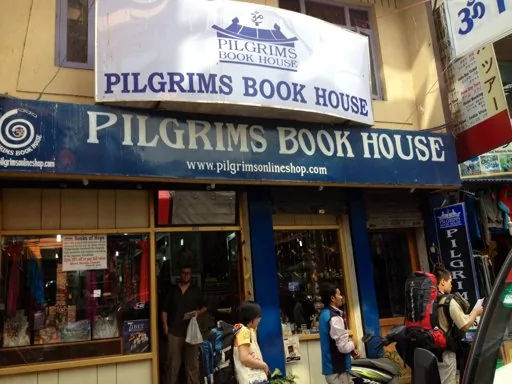
We're a bookshop in Thamel, Kathmandu—the neighbourhood where most trekkers stock up before heading out. We carry mountaineering narratives, trekking guidebooks, and rare Himalayan literature. We also ship across Nepal.
If you're looking for something specific that isn't on our shelves, ask. We've been building relationships with specialist publishers and distributors for forty years. If it exists, we can usually find it.
Useful Links from Pilgrims Book House
Explore related collections at Pilgrims
Browse more on our shelves: Mountaineering & Climbing, Trekking Guidebooks, Nepal Travel & Tourism.



.webp)
